From The Grimoire
Discover the Wonderful Yule Legend of the Oak and Holly Kings
iscover the Yule legend of the Oak and Holly Kings, whose eternal battle symbolises the cycle of light and dark, balance, and renewal.
Table of Contents
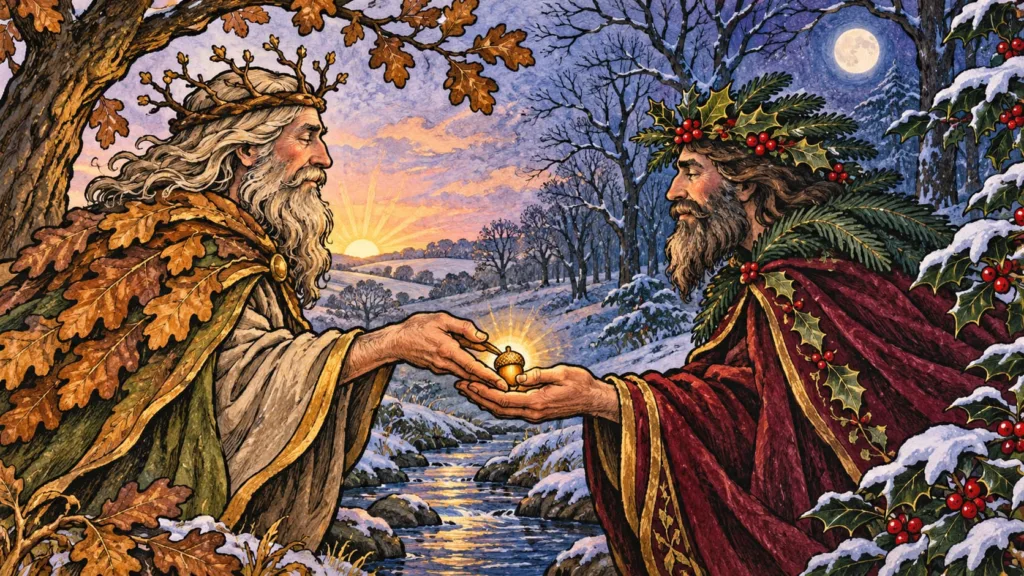
Every Yule, when the nights seem to have been switched to permanent and half the country is somehow tired by 10am, the story of the Oak King and Holly King does the rounds again. It has stuck around because it gives us a useful image for the year’s turning: light and dark, action and rest, growth and recovery.
At Yule, the Oak King is said to take the crown as daylight begins its slow return. At Midsummer, the Holly King rises as the days begin to shorten. Neither is the villain. Neither is meant to win forever.
That is the bit that matters. The wheel turns. Different seasons ask different things of us, and not all of them are about striving harder.
The Oak King and Holly King Story in Brief
In the familiar modern version of the tale, the Oak King and Holly King are seasonal figures who take turns ruling the year. The Oak King represents the waxing light from Yule to Midsummer. The Holly King represents the waning light from Midsummer back to Yule.
At each solstice, one king yields to the other. The image is sometimes told as a battle, but it works better as a handover. The point is not that one is good and the other is bad. The point is that both halves of the cycle are necessary.
At Yule, the Oak King’s return can symbolise hope, renewal and the first small movement towards spring. It is a beginning, but a quiet one. The sun does not suddenly appear blazing over Lancashire on 22 December. It returns minute by minute.
Is This an Ancient Celtic Myth?
It is worth being honest here. The Oak King and Holly King story as most modern witches know it is not a neatly preserved ancient Celtic myth with one agreed original version. The familiar framework has been shaped by 20th-century writers and modern Pagan practice, drawing on older seasonal symbolism around oak, holly, evergreens and the solstices.
That does not make it meaningless or “fake”. Folklore evolves. So do family traditions, religious practices and the stories people use to understand the natural world. It simply means we do not need to pretend the myth arrived untouched from a misty prehistoric hillside.
You can work with it as a modern seasonal story: a useful, beautiful metaphor for the balance between outward energy and inward rest.
The Oak King: Returning Light and Growing Energy
The Oak King is commonly associated with the lighter half of the year, from Yule to Midsummer. His symbolism often includes growth, warmth, movement, confidence, fertility, fire and the returning sun.
Oak itself carries a strong presence in British folklore and landscape. A mature oak suggests patience, rootedness and survival across long spans of time, while the returning light at Yule offers a small but genuine sign that winter will not last forever.
For a Yule practice, the Oak King can represent the hope you are tending. Not a demand to become a brand-new person by January. More the first small spark of something you want to nourish as the days lengthen.
The Holly King: Protection, Rest and Endurance
The Holly King is commonly associated with the darker half of the year, from Midsummer to Yule. His imagery is quieter: evergreens, moonlight, protection, reflection, shelter and the endurance needed to get through harder seasons.
Holly is prickly for a reason, which makes it a useful symbol for boundaries. It is not an aggressive kind of protection. It is the ability to keep a little warmth and safety inside your own space when everything outside feels demanding.
The Holly King reminds us that rest is not weakness and stillness is not failure. Winter asks for a different kind of strength, and a quieter practice is still a practice.
The Solstices and the Turning Year
At the Winter Solstice, the Oak King is traditionally said to rise as daylight begins to increase. At the Summer Solstice, the Holly King returns as the days begin their slow shortening. Some practitioners use slightly different versions, and that is fine. The myth is a seasonal framework, not a legal contract.
The important thing is the rhythm. Every peak contains the beginning of a descent. Every dark season contains the beginning of a return. Nature does not hold a steady, endlessly productive line, and neither do people.
That can be a useful corrective when modern life keeps insisting we should be at our most energetic, motivated and available all year round. Absolutely not. The trees are not doing that, and they have been at it longer than we have.
What the Two Kings Can Symbolise
Whether or not you relate to the kings as literal spiritual beings, their contrast gives you plenty to work with:
- Oak King: outward energy, action, courage, growth, warmth and possibility.
- Holly King: inward focus, protection, rest, resilience, boundaries and reflection.
- Together: balance, change, acceptance and the knowledge that no season lasts forever.
We all move between these energies. There are weeks when you are full of plans and weeks when getting dressed deserves a small medal. One is not morally better than the other. Both belong to a whole life.
Work With the Myth Without Overcomplicating It
You do not need a formal ritual or a dramatic declaration to connect with this story. Start by asking which energy you need more of right now.
If you need Oak King energy, choose one practical action that supports a hope you have been carrying. Make the appointment, apply for the thing, begin the project, tidy the one surface that has become a spiritual test. Then give yourself credit for moving.
If you need Holly King energy, protect an evening, rest without trying to turn it into self-improvement, say no to one unnecessary demand or make your home feel safer and warmer. The myth works best alongside real-world care and choices, not instead of them.
Make a Simple Oak and Holly Yule Altar
A small Yule altar can hold symbols of both halves of the year. Keep it simple and use what is safe and available:
- An acorn, oak leaf or piece of wood for the Oak King.
- A holly image, evergreen sprig or pinecone for the Holly King.
- A gold, white or LED candle for the returning light.
- Red and green fabric, ribbon or decorations.
- A small note naming one thing you are releasing and one thing you want to grow.
Keep greenery well away from flames, and remember that some plants are not safe for pets or children. An image or a paper symbol works perfectly well. You are building meaning, not a fire hazard.
Yule Reflection Questions
Set aside a few quiet minutes with a notebook, a warm drink or simply the full force of your own thoughts. Ask:
- Where in my life do I need more Oak King energy: action, courage or a fresh start?
- Where do I need more Holly King energy: rest, boundaries or protection?
- What has this darker season taught me?
- What small hope am I ready to tend now?
- What can I stop carrying into the next turn of the wheel?
You do not need a dramatic answer. A useful answer might be “go to bed earlier” or “stop replying to that person immediately”. Wisdom often looks suspiciously ordinary when it first turns up.
More Yule Magic to Explore
These connected guides can help you carry the seasonal theme into a practical Yule celebration:
Both Seasons Belong
The Oak King and Holly King are a reminder that light and dark need each other. We are allowed to grow, act and reach out. We are also allowed to rest, retreat and protect what matters.
At Yule, let the returning light be small. Let it be real. A candle, a decision, a boundary or one tiny bit of hope is plenty to begin with.
Handcrafted Tools