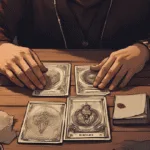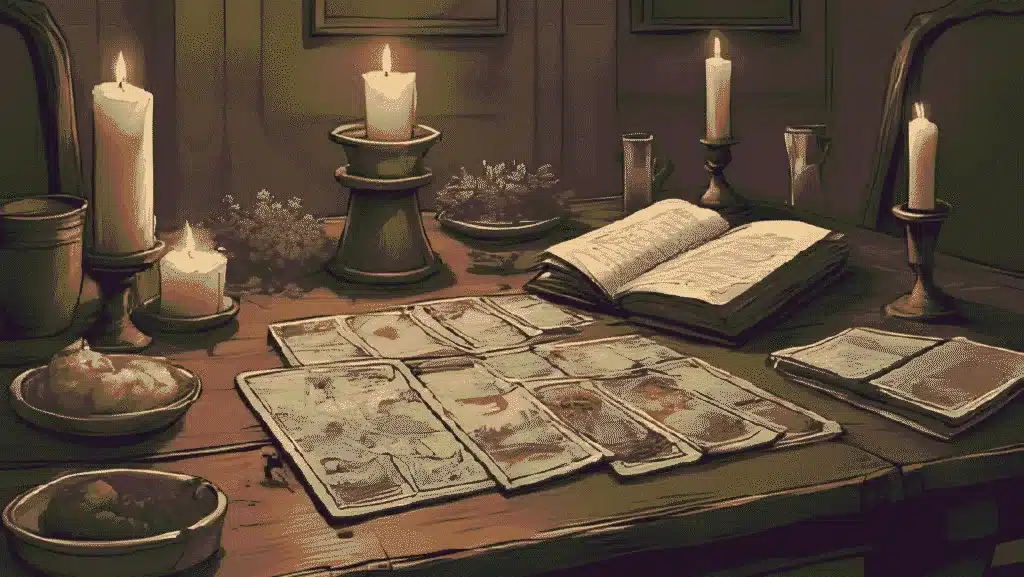
A lot of people assume tarot arrived fully formed out of some ancient misty temple where mysterious priestesses dramatically whispered prophecies while waving incense around.
Which sounds wonderfully atmospheric.
But the truth is far more human, slightly chaotic, and honestly?
Quite comforting.
Because tarot didn’t begin as a sacred occult system at all.
It started as a card game.
Which feels very on-brand for humanity really.
Take something fun, accidentally make it mystical several hundred years later.
And yet somehow…
that strange journey is exactly what makes tarot so fascinating.
Renaissance Italy: Tarot Starts as a Fancy Game
Tarot first appeared in 15th century Italy.
Back then it wasn’t called “tarot” in the mystical sense we think of now. It was known as tarocchi, and wealthy families commissioned elaborate hand-painted decks to play trick-taking card games.
Think:
rich nobles,
beautiful artwork,
dramatic family politics,
and somebody absolutely insisting they weren’t cheating while clearly cheating.
Very little changes, honestly.
The earliest decks already contained:
- Cups
- Swords
- Coins/Pentacles
- Batons/Wands
alongside special trump cards that later became what we now call the Major Arcana.
Cards like:
- The Fool
- Death
- The Wheel of Fortune
- The Magician
already existed.
But they weren’t originally viewed as mystical symbols.
They were game pieces.
Gorgeous ones, admittedly.
So… Where Did the Magic Come From?
Several centuries later, occultists got hold of tarot and basically went:
“…hang on a minute.”
By the 1700s, European mystics started claiming tarot contained hidden spiritual wisdom.
One French writer, Antoine Court de Gébelin, became convinced tarot came from ancient Egypt and secretly preserved mystical teachings from the legendary Book of Thoth.
This was an incredibly dramatic theory.
Also:
almost certainly nonsense.
Historians now agree tarot originated in Europe, not Egypt.
But honestly?
Witches do love symbolism, mystery, and layered meaning. So the idea stuck around because it felt magical.
And once people started viewing tarot through an occult lens, everything changed.
Tarot Becomes Occult
By the 1800s, secret societies and magical orders became obsessed with symbolic systems.
Particularly:
the Hermetic Order of the Golden Dawn.
Which sounds exactly like the kind of organisation that absolutely would meet in candlelit rooms while discussing astrology until 2am.
The Golden Dawn connected tarot to:
- astrology
- Kabbalah
- alchemy
- numerology
- ceremonial magic
Suddenly tarot wasn’t just a game anymore.
It became:
- a spiritual map
- a magical language
- a psychological mirror
- a symbolic system for understanding human experience
Which honestly explains why it still resonates so strongly today.
Humans love stories.
Humans love symbols.
Humans desperately want reassurance that their current emotional chaos means something.
Tarot offers all three.
The Rider-Waite-Smith Deck Changes Everything
If you’ve ever bought a beginner tarot deck, there’s a very high chance it was based on the Rider-Waite-Smith system.
Published in 1909, it became the blueprint for most modern tarot.
Arthur Edward Waite provided the esoteric direction, but the artwork itself was created by Pamela Colman Smith.
And frankly?
Pamela deserves far more credit than history originally gave her.
Her illustrations transformed tarot completely because for the first time, even the numbered suit cards had detailed scenes and emotional storytelling.
Before that, many decks just showed:
“here are five swords.”
Which admittedly leaves a lot of interpretive heavy lifting.
Pamela’s artwork made tarot intuitive.
You could feel the cards.
That’s why modern beginners still connect with it so easily.
Tarot in Modern Witchcraft
Fast forward to the 20th century and tarot became deeply woven into modern witchcraft.
Particularly during:
- the rise of Wicca
- the New Age movement
- the explosion of spiritual publishing in the 70s and 80s
Suddenly tarot wasn’t reserved for occult societies anymore.
Ordinary people started reading tarot at:
- kitchen tables
- festivals
- bookshops
- coven meetings
- university dorms
- slightly chaotic living rooms full of candles and cats
Which honestly feels exactly where tarot belongs.
Today tarot exists in this fascinating space between:
- spirituality
- psychology
- intuition
- storytelling
- symbolism
- ritual
Some people view it as mystical divination.
Others see it as subconscious reflection.
Personally?
I think it works beautifully as both.
Why Tarot Still Feels Magical
Here’s the thing.
Even once you understand the history and psychology behind tarot…
it doesn’t stop feeling magical.
If anything, it becomes more interesting.
Because tarot works through:
- symbolism
- intuition
- projection
- archetypes
- emotional honesty
The cards become mirrors.
And honestly?
That can be far more confronting than fortune telling.
Nothing humbles a person faster than pulling The Tower after ignoring obvious red flags for six months.
Spiritually rude behaviour from a deck of cardboard, frankly.
Tarot for Beginners Today
One of the lovely things about tarot now is how accessible it’s become.
You don’t need:
- secret occult knowledge
- psychic powers
- expensive tools
- perfect intuition
- an aesthetic Instagram altar
You just need curiosity and willingness to listen to yourself honestly.
That’s really the heart of tarot.
Not predicting doom.
Not mystical perfection.
Just:
paying attention.
To your patterns.
Your fears.
Your hopes.
Your instincts.
And occasionally being emotionally called out by The Hermit while drinking tea in fluffy socks.
Very modern witchcraft.
Final Thoughts
Tarot has lived many lives.
It began as:
a Renaissance card game.
Then became:
an occult system layered with symbolism and spiritual meaning.
And now?
It’s part of modern witchcraft, self-reflection, healing, creativity, and intuitive practice.
That journey is exactly what makes tarot so powerful.
It adapts.
It evolves.
It grows alongside the people using it.
Which honestly feels quite witchy in itself.
So whether you approach tarot as:
- psychology
- spirituality
- magic
- ritual
- storytelling
- or simply a comforting conversation with yourself
the cards still have something to say.
And after several hundred years of surviving nobles, mystics, occultists, and modern life…
they’ve clearly got staying power.