From The Grimoire
Salt: Magical Properties and How to Use It in Witchcraft
Salt is one of the most practical ingredients in witchcraft: cheap, familiar and useful without pretending it is a dramatic supernatural substance in a tin
Table of Contents
Salt is probably the least glamorous thing in the cupboard and one of the most useful magical tools a witch can keep. It is affordable, familiar and wonderfully unbothered by whether your altar is an elaborate thing of beauty or a corner of the kitchen table cleared between tea and life admin.
In modern witchcraft, people commonly work with salt for symbolic cleansing, protection, grounding, boundaries and steadiness. A pinch can mark the beginning of a ritual; a contained bowl can become a visual reminder that your home is allowed to feel peaceful. That does not mean salt has to be dramatic, rare or expensive. Ordinary kitchen salt is enough.
This is a guide to spiritual and symbolic practice, not a claim that salt can diagnose, treat or prevent physical or mental-health problems. Let magic support your care, boundaries and routines; it does not replace practical action, professional help or a good old-fashioned conversation when one is needed.
Salt at a glance
- Common name: Salt; common kitchen salt is sodium chloride
- Magical themes: Cleansing, protection, grounding, boundaries, stability and preservation
- Useful forms: Table salt, sea salt, salt flakes, pink salt, black ritual salt and Epsom salts for non-food bath use
- Best approach: Use small, contained amounts and clear them away afterwards
- A practical note: Correspondences vary between traditions; use the meanings that genuinely fit your practice
Why salt feels so at home in witchcraft
Salt has always belonged to everyday life. It seasons food, helps preserve it and dissolves in water; it comes from the sea, brine and rock. In Britain, salt production and the preserving of food were important parts of life long before the modern kitchen cupboard. Historic England’s records of salterns show how valuable salt was for preserving and curing food, which gives some useful context for its lasting symbolism of keeping, guarding and making things last.
That practical history is not proof that every modern salt ritual is ancient, and it is worth being honest about that. Folk customs vary between regions, families and faiths. Modern witchcraft also borrows, adapts and creates. You do not need to pretend there is one single correct lineage in order to use a humble household ingredient thoughtfully.
For me, salt works best as a physical focus for an intention. It gives your hands something to do while your mind catches up: a small, sensible ritual object for moments when you need to settle, draw a boundary or make a space feel like your own again.
The magical properties of salt
Cleansing and fresh starts
Salt is often used before ritual or after a difficult day because it represents clearing away what feels stale, heavy or simply no longer helpful. That might mean opening a window, washing a small bowl, lighting a candle safely and setting out a fresh pinch of salt while you name what you are ready to leave behind. The ritual is not about pretending an argument, illness or burnout can be swept away with a teaspoon. It is a pause: a way of choosing what you want to carry forward.
Protection and boundaries
A line of salt is a very clear symbol: this is the edge. In a protection ritual, it can stand for the boundary around your home, your time, your energy or your private thoughts. You are not using it to live in fear of every passing bad vibe. You are reminding yourself that not every demand, mood or opinion gets to move in and make itself at home.
Grounding and stability
Salt is solid, ordinary and connected with both earth and sea. That makes it a lovely anchor for grounding work after tarot, journalling, shadow work or any ritual that has left you a bit emotionally floaty. Hold a closed container of salt, put both feet on the floor and breathe slowly. Let the physical sensation bring you back to the present before you rush off to overthink the entire experience.
Preservation and keeping what matters
Because salt has a real-world history of preserving food, many witches also use it symbolically for keeping a promise, protecting a peaceful habit or giving a long-term intention a steady foundation. This is not flashy manifestation magic. It is more ‘make the budget, drink some water, send the email and keep showing up’ energy. Frankly, that sort of magic tends to be more useful.
What is salt used for in witchcraft?
What is salt used for in witchcraft? Most often, it is used to give a physical shape to cleansing, protection and grounding. The following ideas are deliberately simple. Choose one that suits your home and your circumstances rather than trying to turn your living room into a low-budget supernatural obstacle course.
1. A contained salt bowl for your doorway or altar
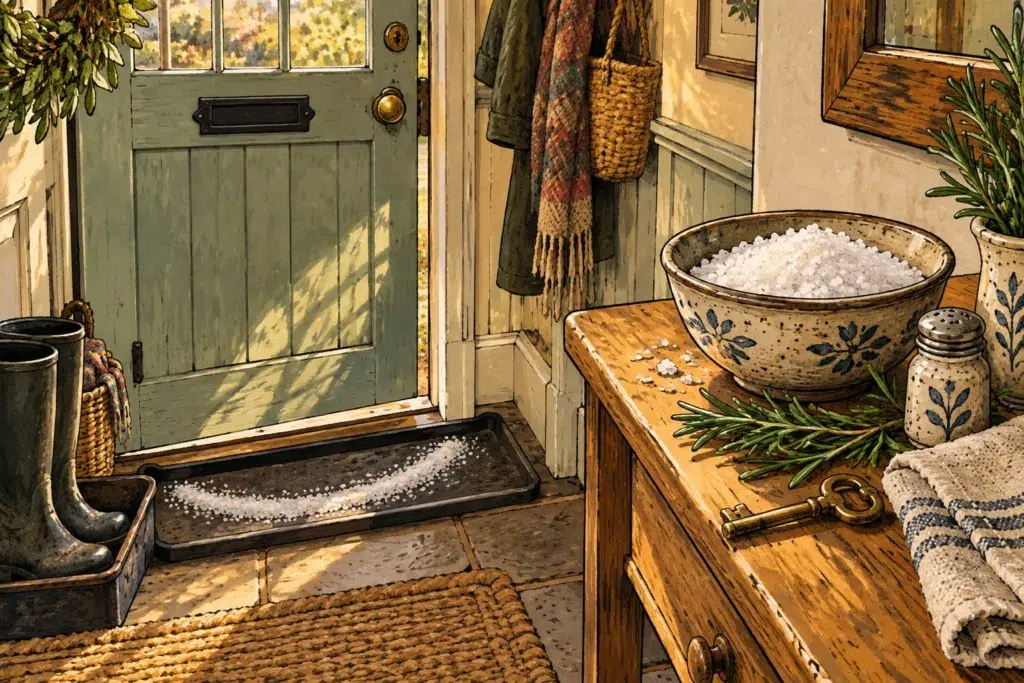
Put a spoonful of plain salt in a small dish or lidded jar and place it near your front door, on a shelf or beside your altar. Hold the bowl for a moment and set a clear intention, such as: ‘This home is a place of rest, honesty and good boundaries.’ Refresh it when it looks grubby, damp or forgotten. Dispose of the old salt in the household bin rather than scattering it outside.
2. A reset for ritual tools
Place a small dish of salt beside the tools you use for ritual: cards, a journal, a candle holder or a charm bag. You do not need to bury delicate items in salt or rub it into metals, wood or crystals; some materials can be scratched, stained or corroded. The salt can sit nearby as a symbolic boundary while you clean the objects properly in the way their material requires.
3. A small indoor circle or working boundary
If you like casting a circle, use a very light line of salt on a wipeable indoor surface, or place four tiny bowls at the edges of your working space. When you are finished, sweep it up and put it in the bin. A circle is there to help you focus and mark the ritual, not to make a mess you will resent hoovering for the next three weeks.
4. A hand-washing or bath ritual
Add a small amount of suitable bath salt to warm water, or dissolve a pinch of ordinary salt in a bowl for a symbolic hand wash. As you rinse, imagine the day ending at your wrists and flowing away. Keep this gentle: stop if anything stings, do not use salt on broken or irritated skin, and remember that a bath ritual can be comforting without being medical treatment.
5. A spell jar or sachet for steadiness
Add a little salt to a jar or pouch with a written intention. For example, pair it with a bay leaf for a goal you want to protect, rosemary for a clear-headed home ritual, or a coin for steadier money habits. Keep the wording grounded: ask for clarity, opportunity, confidence and sensible decisions, then follow it up with the very ordinary action that gives the spell somewhere to land.
6. A post-argument home reset
After a tense day, open a window if you can, tidy one small area and put a bowl of salt on the side while you take a few slow breaths. You might say, ‘The argument is over. This room can be peaceful again.’ Once you feel ready, clear the bowl away. It is a small act, but small acts are often where a home begins to feel safe again.
Which type of salt should you use?
You do not need a shelf full of colour-coded salt to be a proper witch. The best choice is usually the one you already have and can use responsibly.
Table salt
Plain table salt is inexpensive, easy to find and absolutely fine for contained spell work, bowls, jars and small indoor circles. Use it when the intention matters more than the aesthetic, which is most of the time.
Sea salt and salt flakes
Sea salt is often chosen when you want a connection with cleansing, emotion, intuition or the sea. It is lovely in a contained bowl or a bath product designed for skin use. It is not automatically more powerful than ordinary salt; it simply gives you a different visual and sensory focus.
Pink salt
Pink salt is often used in modern witchcraft for softness, self-worth, compassion and emotional gentleness. If that language resonates, use it. If you only have table salt, your ritual has not failed before it began. You can read more about its particular symbolism in the Lancs Green Witch pink salt guide.
Black ritual salt
Black ritual salt is generally worked with for banishing, protection and firm boundaries. It is not the same thing as culinary black salt, and a ritual blend may contain ash, charcoal, herbs or other materials that are not for eating or bathing in. Label it clearly, keep it away from children and pets, and treat it as an external ritual ingredient only. For more, see the black salt guide.
Epsom salts
Epsom salts are magnesium sulphate rather than sodium chloride. Some people use them in baths because they dissolve well, but they are not a swap for culinary salt and should only be used as directed on the product. In magical terms, their use is a personal association, not a rule.
Salt correspondences: useful prompts, not universal rules
You will often see salt linked with protection, cleansing, Earth, water, Saturn, the sea or ancestral household magic. Treat those as starting points rather than a quiz you can fail. Correspondences are a language for organising intention. If salt feels like the sea to you, work with that. If it feels like a well-kept kitchen, a safe home or a clean slate, that is just as valid.
The important thing is to be clear about what you mean by it. ‘I use salt for a boundary around my peace’ is a stronger foundation than throwing in every correspondence from a chart and hoping one of them does the heavy lifting.
Use salt safely and respectfully
Salt is a household food ingredient, but it still needs common sense in ritual use. The Royal Horticultural Society notes that salts can damage soil structure, and the RSPCA warns that even small amounts of pure salt can be dangerous if eaten by pets. That makes the responsible approach very straightforward: keep it contained, keep it indoors where possible and clear it away.
- Do not scatter salt into gardens, soil, lawns, waterways or wild places.
- Keep bowls, ritual salt and salt water out of reach of children and pets; never leave it where an animal may lick or drink it.
- Do not use non-food ritual salts, black salt blends or unknown mixtures in cooking, drinks or baths.
- Avoid rubbing salt onto delicate tools, metals, porous stones or crystals that could be damaged.
- Dispose of small used ritual amounts in the household bin, or dissolve only plain food-grade salt in plenty of water indoors and rinse it away.
- Use practical support alongside magic. Salt can hold an intention; it cannot replace healthcare, safeguarding, legal advice or a needed boundary conversation.
A five-minute salt reset for a chaotic day
You will need a small dish, a spoonful of plain salt and somewhere quiet enough to take five minutes without being interrupted by a family member asking where their clean socks are.
- Put the salt in the dish and place it in front of you.
- Take three slow breaths with both feet on the floor.
- Name one thing you are finished carrying today and one thing you want to protect tomorrow.
- Say: ‘I clear what is not mine to carry. I keep what helps me feel steady.’
- Put the bowl somewhere safely out of reach, then clear it away later and put the salt in the bin.
That is enough. A ritual does not become more meaningful because you made it harder to complete.
Frequently asked questions about salt in witchcraft
Is ordinary table salt good enough for witchcraft?
Yes. Plain table salt is perfectly suitable for most contained, symbolic uses. Choose a speciality salt only when its colour, texture or personal associations genuinely add something to the ritual.
Can I sprinkle salt outside my front door for protection?
It is kinder to the garden, wildlife and pets to use a contained bowl indoors, a tiny indoor threshold line that you clear away, or a non-salt alternative such as a spoken blessing, a ribbon, a charm or a swept doorstep. Protection work should not leave harm behind it.
Can salt remove negative energy?
Many witches use salt as a symbol of cleansing and a focus for a reset. Treat that as spiritual practice, not a measurable guarantee. If a situation is making you feel unsafe, overwhelmed or unwell, use the practical support it calls for as well.
What is salt used for in witchcraft when I am a complete beginner?
Start with a contained bowl on your altar or by your door, paired with a simple sentence about the kind of home or headspace you want to create. It is inexpensive, low-fuss and a good way to learn how your own practice feels before you buy anything else.
Do I need to cleanse salt before I use it?
No. You can if the action helps you settle into the ritual, but you do not need to cleanse every ordinary household ingredient before it can be meaningful. Your attention and intention are the important part.
Final thoughts: ordinary magic is still magic
Salt is a brilliant reminder that witchcraft does not need to be expensive, theatrical or perfect to matter. A contained bowl by the door, a gentle bath ritual, a line that says ‘this is my space’ – these are small, practical ways to return to yourself.
Use salt with respect for your home, your pets, the land and the people around you. Let it support clearer boundaries and steadier habits, rather than asking it to do the work only you can do. That is where its quiet magic lives.
Sources and further reading
For the practical history and safety notes in this article, see:
Handcrafted Tools