From The Grimoire
What Is Shadow Work? A Gentle Guide for Beginners
Shadow work sounds dramatic. The name conjures dark mirrors, hidden selves and the sort of intense spiritual revelation that presumably requires a.
Table of Contents

Shadow work sounds dramatic.
The name conjures dark mirrors, hidden selves and the sort of intense spiritual revelation that presumably requires a black candle and several hours of atmospheric rain.
In practice, it can be much quieter.
Shadow work is commonly used in modern spiritual and self-reflective practices to describe exploring the parts of ourselves we avoid, suppress, judge or struggle to understand.
That might include anger, jealousy, fear, shame, people-pleasing, insecurity, old patterns or qualities we were taught were unacceptable.
But shadow work is not a magical substitute for therapy.
And it does not require digging through every painful experience you’ve ever had because the internet gave you a journal prompt.
You are allowed to approach self-reflection gently.
Where Does the Idea of the Shadow Come From?
The language of the psychological shadow is strongly associated with Swiss psychiatrist Carl Jung, whose work explored unconscious aspects of personality, including qualities people may reject or fail to recognise in themselves.
Modern witchcraft and spiritual communities have adopted and adapted the phrase shadow work in many ways.
As a result, what somebody means by shadow work online may not be identical to Jungian psychology or to professional psychotherapy.
In witchcraft, the term often describes deliberate personal reflection around hidden emotions, recurring patterns, uncomfortable reactions and parts of the self we would rather not look at.
It is useful to understand that distinction.
A journal exercise inspired by the idea of the shadow is not the same thing as psychological treatment.
What Can Be Part of the Shadow?
People sometimes assume the shadow means our evil side.
It can be much broader than that.
Perhaps you learned that anger was unacceptable, so you suppress it until resentment builds.
Perhaps you were praised for being easy-going, so asking for help now feels selfish.
Perhaps confidence was treated as arrogance, so you hide your abilities.
Perhaps you judge people who rest because you were taught your own worth comes from productivity.
The shadow can contain qualities we dislike.
It can also contain qualities we were never given permission to express.
Sometimes the hidden part isn’t monstrous.
Sometimes it just wants a bloody afternoon off.
Why Do Witches Practise Shadow Work?
Witchcraft often involves intention.
We ask what we want to change, attract, release, protect or understand.
Shadow work can help reveal the patterns underneath those intentions.
You might repeatedly cast confidence spells while avoiding situations where you could be seen.
You might perform prosperity magic while feeling guilty about charging money for your work.
You might practise protection magic while saying yes to everybody who asks for your time.
You might perform release rituals for the same relationship while continuing to check their social media every night.
The magical working isn’t necessarily wrong.
Shadow work simply asks what else is happening.
Shadow Work Is Not About Blaming Yourself
Self-reflection can become unhealthy when every problem is turned inward.
Not every difficult relationship exists because you need to heal a trigger.
Sometimes somebody treated you badly.
Not every workplace problem reflects an inner wound.
Sometimes the workplace is badly managed.
Not every financial problem comes from limiting beliefs.
Sometimes things are expensive and wages are inadequate.
Shadow work can explore your own reactions and patterns without pretending you caused every difficult circumstance around you.
Sometimes the problem isn’t your shadow.
Sometimes the problem is the problem.
Start Small
Beginner shadow work does not need to start with your most painful memory.
Start with something mildly uncomfortable and current.
A person who irritates you.
A compliment you struggle to accept.
A task you keep avoiding.
A boundary you find difficult to set.
A situation where you become unusually defensive.
Ask what happens inside you around it.
You are learning to notice patterns, not trying to emotionally excavate your entire life in one evening.
A Simple Shadow Work Journal Practice
Choose one recent reaction that felt stronger than expected.
Write what happened as factually as possible.
Then ask:
What did I feel?
What did I want to do?
What story did I immediately tell myself about the situation?
What was I afraid it meant?
Does this reaction feel familiar?
What did I actually need in that moment?
You don’t need to produce a profound revelation.
Sometimes the answer is simply: I was already exhausted and that was the fifth irritating thing that happened before lunch.
Context matters.
Triggers Without Turning Everybody Into a Teacher
The word trigger is used very loosely online.
In everyday spiritual conversation, people often use it to mean something that provokes a strong emotional reaction.
You can certainly learn from strong reactions.
But be cautious of the idea that every person who upsets you has arrived as a spiritual teacher sent to reveal your wounds.
Some people are simply annoying.
Some behaviour is genuinely unacceptable.
The useful question is not always:
Why am I triggered by this?
Sometimes it is:
Why am I continuing to tolerate this?
Shadow work and boundaries can be excellent companions.
Jealousy as Information
Jealousy is uncomfortable, which makes it useful shadow-work material when approached without shame.
Suppose you feel jealous of somebody else’s business, relationship, confidence, home or creative success.
Instead of immediately telling yourself jealousy is bad, ask what information it contains.
Do you want something similar?
Do you feel overlooked?
Are you comparing your beginning with somebody else’s tenth year?
Do you believe their success reduces what is available to you?
Does their confidence remind you of something you suppress in yourself?
Jealousy does not automatically reveal a secret truth, but it can point towards desire, fear and comparison.
Anger and the Shadow
Anger is another emotion frequently pushed into the shadow, especially for people who were taught to remain pleasant, agreeable or accommodating.
Instead of asking how to stop being angry, try asking what the anger is protecting.
A boundary?
A value?
A need?
A sense of fairness?
Exhaustion?
Fear?
Anger can be destructive when acted out harmfully, but feeling anger is not a moral failure.
Sometimes anger is information that something matters.
People-Pleasing
People-pleasing can look very kind from the outside.
Helpful.
Reliable.
Easy to work with.
Always available.
Shadow work might ask what happens when you consider disappointing somebody.
Do you fear rejection?
Conflict?
Being thought selfish?
Being difficult?
Do you feel responsible for other people’s emotions?
Then notice the cost.
Resentment.
Exhaustion.
No time for yourself.
Agreeing to things you don’t want.
A shadow-work insight becomes useful when it leads to a healthier choice, such as a boundary.
Your journal cannot say no for you.
Unfortunately.
Perfectionism
Perfectionism often presents itself as having high standards.
Sometimes it is.
Sometimes it is fear wearing a very organised outfit.
What happens if the work is merely good?
What would it mean if somebody found a mistake?
Do you delay finishing because unfinished work cannot yet be judged?
Do you endlessly prepare instead of beginning?
Shadow work around perfectionism can reveal fear of criticism, rejection or not being good enough.
Then the practical experiment might be deliberately allowing something low-stakes to be finished rather than perfect.
Creation has to happen before perfection gets a vote.
Shadow Work and the Dark Half of the Year
Many witches naturally associate shadow work with autumn and winter.
As the days shorten after the harvest season, the inward symbolism can feel particularly appropriate.
Samhain is often connected with ancestors, endings and reflection.
Winter itself invites quieter rhythms for many people.
But you do not need to wait for the dark half of the Wheel.
Shadow work can happen whenever reflection is useful.
And seasonal symbolism should support you rather than pressuring you into emotional excavation because October arrived.
A Candle Practice for Gentle Reflection
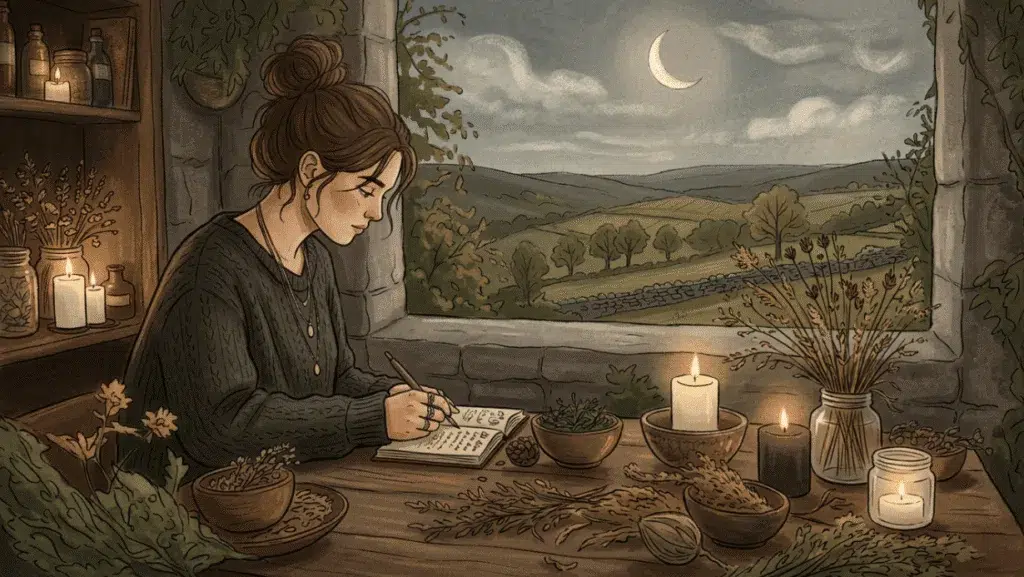
Choose a quiet space and a candle if using one feels helpful.
Light it safely.
Ask one question only.
What am I avoiding because it feels uncomfortable to admit?
Write whatever comes up for ten minutes.
Then stop.
You do not have to solve the answer immediately.
Close the journal.
Extinguish the candle.
Do something grounding and ordinary.
Make tea.
Wash your face.
Watch something familiar.
Talk to somebody you trust.
A ritual can open reflection without requiring you to stay emotionally submerged in it all evening.
Using Tarot for Shadow Work
Tarot can provide prompts for reflection, but it should not be used to diagnose mental-health conditions or tell you with certainty what hidden trauma you have.
Keep questions open and grounded.
What am I not acknowledging about this situation?
What belief is influencing my reaction?
What boundary needs attention?
What strength am I overlooking?
What would support me as I work through this?
Pull one or two cards and use the imagery as a journalling prompt.
If the reading becomes frightening, obsessive or distressing, put the cards away.
You are allowed to stop asking.
A Three-Card Shadow Work Spread
Card One: What am I currently avoiding?
Card Two: What might this reaction be protecting?
Card Three: What would a gentle next step look like?
The third card matters.
Shadow work should not only identify pain. It should help you move towards something useful.
Self-compassion.
A boundary.
Rest.
A conversation.
Professional support.
Acceptance.
Action.
Shadow Work Without Tarot
You don’t need divination tools.
Try sentence starters:
I get defensive when…
I find it difficult to admit…
I wish I were allowed to…
I judge people when they…
I feel jealous when…
I am afraid people will discover…
I keep saying yes when…
The part of myself I find hardest to accept is…
Write for a few minutes, then read it back with curiosity rather than prosecution.
You are investigating, not building a court case against yourself.
When Shadow Work Becomes Too Much
Stop.
That is a complete instruction.
If an exercise brings up intense distress, traumatic memories, panic, dissociation, urges to harm yourself or feelings that you cannot manage safely, a witchcraft journal is not the right container for that experience.
Seek appropriate professional or urgent support depending on what is happening.
You do not receive spiritual bonus points for handling everything alone.
Shadow work should never be used as a reason to avoid mental-health care.
Can Shadow Work Replace Therapy?
No.
Reflective journalling and spiritual practices can sit alongside therapy for some people, but they are not equivalent.
A trained mental-health professional brings assessment, boundaries, evidence-based approaches and a relationship specifically structured to support psychological work.
A Pinterest prompt does not.
If you are dealing with trauma, persistent anxiety or depression, intrusive thoughts, severe distress or patterns significantly affecting daily life, professional support may be much more appropriate than trying to dig deeper alone.
You are Allowed to Have Limits
You do not need to uncover every hidden part of yourself.
You do not need to forgive everybody.
You do not need to turn every wound into wisdom.
You do not need to find gratitude for painful experiences.
You do not need to confront somebody because a journal prompt suggested closure.
Sometimes understanding is enough.
Sometimes distance is enough.
Sometimes the healthiest conclusion is: I don’t want that in my life anymore.
Shadow Work Can Include Positive Qualities
Here’s the bit that often gets missed.
What qualities do you admire in other people but struggle to claim for yourself?
Confidence?
Creativity?
Sensuality?
Ambition?
Leadership?
Restfulness?
Independence?
Maybe you learned that being visible was showing off.
Maybe wanting money was greedy.
Maybe anger was unfeminine.
Maybe resting was lazy.
Maybe saying no was selfish.
The shadow can contain your unclaimed strengths too.
A Positive Shadow Prompt
Choose somebody you admire.
Write down three qualities you associate with them.
Then ask:
Where does a version of this quality already exist in me?
Not where could it exist someday.
Where is it already present?
Perhaps their courage reminds you of the time you did something difficult despite being frightened.
Perhaps their creativity reflects something you keep treating as a silly hobby.
Perhaps their confidence irritates you partly because you want permission to take up more space yourself.
That can be very interesting territory.
What Do You Do With a Shadow Work Insight?
You don’t have to create another ritual.
Suppose you realise you resent people asking for help because you never say no.
The next step may be practising no.
Suppose you realise jealousy is showing you that you want to pursue creative work seriously.
The next step may be making time for it.
Suppose you realise perfectionism is preventing you publishing anything.
The next step may be publishing something good enough.
Insight becomes useful through changed behaviour.
Otherwise we can become extremely self-aware while continuing to do exactly the same thing.
A Gentle Shadow Work Routine
Try this once a week or whenever it feels useful:
Choose one small current issue.
Write for ten minutes.
Identify the emotion.
Ask what it might be protecting or asking for.
Choose one compassionate practical response.
Close the journal.
Do something grounding.
That is enough.
You do not need a 90-day shadow-work challenge.
Your subconscious has not subscribed to a content calendar.
The Goal Is Not to Become All Light
Shadow work is sometimes described as integrating darkness so we can become more whole.
I prefer to think of it more simply.
We all contain contradictory feelings, needs, fears, strengths and habits.
Some are easy to admit.
Some aren’t.
Looking at the difficult ones with curiosity can give us more choice about what we do next.
That does not mean loving every part of ourselves or turning harmful behaviour into an identity we must embrace.
It means being willing to notice what is actually there.
Gently.
Honestly.
Without trying to spiritually bully ourselves into transformation by bedtime.
Sometimes the bravest shadow work is not opening another door.
It’s recognising when you’ve done enough for today and closing the journal.
Handcrafted Tools