From The Grimoire
Dark Moon Shadow Work: Questions Worth Asking
The dark moon has acquired a reputation for being the bit of the lunar cycle where we're supposed to become terribly mysterious. Apparently this is.
Table of Contents
The dark moon has acquired a reputation for being the bit of the lunar cycle where we’re supposed to become terribly mysterious.
Apparently this is when we retreat into the shadows, confront our deepest wounds, release everything that no longer serves us and emerge three days later transformed into somebody with excellent boundaries and an organised spice cupboard.
Real self-reflection is usually less tidy.
The dark moon can be a useful symbolic time for quiet, endings, rest and honest reflection. It can also be a perfectly ordinary evening when you’re tired and don’t particularly fancy emotionally excavating your childhood.
Both are allowed.
If you want to use the dark moon for shadow work, the quality of the question matters more than how many journal pages you fill.
What Is the Dark Moon?
The phrase dark moon is used differently across modern witchcraft and astrology.
Some people use dark moon and new moon interchangeably. Others use dark moon specifically for the period immediately before the astronomical new moon, when the Moon is not visibly illuminated from Earth.
In personal witchcraft, the symbolism is often more important than arguing over terminology.
The dark phase can represent quiet, withdrawal, endings, uncertainty, unseen processes and the pause before a new lunar cycle begins.
That makes it a natural fit for reflection.
Why Pair the Dark Moon With Shadow Work?
Shadow work explores emotions, beliefs, reactions and parts of ourselves we may avoid or suppress.
The dark moon offers a symbolic container for that work.
Not because difficult emotions become magically accessible on one particular night.
Because recurring ritual timing can help us remember to pause.
Once each lunar cycle, you might ask:
What has been bothering me?
What am I avoiding?
What needs to end?
What needs rest rather than fixing?
That can be enough.
You Don't Need to Dig for Trauma
Shadow work is not a competition to find the most painful possible material.
You can reflect on irritation.
Procrastination.
Jealousy.
People-pleasing.
A conversation you keep replaying.
A boundary you didn’t set.
Something you secretly want but feel embarrassed to admit.
If a journal prompt brings up traumatic memories or distress you cannot safely manage, stop. Spiritual journalling is not a replacement for appropriate mental-health support.
The dark moon does not require suffering as an offering.
Question 1: What Am I Avoiding Because the Answer Is Inconvenient?
This is one of my favourites because inconvenient truths are often much more common than dramatic hidden ones.
Perhaps you know the project isn’t working.
You know you’re exhausted.
You know somebody keeps crossing a boundary.
You know you don’t actually want the thing you’ve spent months pursuing.
You know the price is too low.
You know you need to make the phone call.
Write the answer without immediately demanding a solution.
Sometimes admitting the obvious is the work.
Question 2: Where Am I Saying Yes When I Mean No?
Look at work, family, friendships, volunteering, customers and your own expectations.
Where does yes leave resentment behind?
Where do you agree because explaining no feels harder?
Where are you afraid somebody will think you’re selfish, difficult or unreliable?
Then ask a second question:
What would a smaller, safer boundary look like?
Shadow work becomes useful when it leads towards choice.
Question 3: What Am I Angry About?
Not what should you be angry about.
What are you actually angry about?
Write it without making the emotion polite.
Then ask what the anger may be protecting.
A boundary?
A value?
A need for rest?
A sense of fairness?
Fear?
Feeling overlooked?
Anger is information. What we do with it still matters, but feeling it does not make you a bad witch or a bad person.
Question 4: Who Am I Jealous Of, and What Does That Show Me?
Jealousy is uncomfortable enough that we often immediately judge ourselves for it.
Try curiosity instead.
What does the other person appear to have?
Freedom?
Confidence?
Recognition?
Money?
Creativity?
A relationship?
Time?
Does jealousy reveal something you want?
Or are you comparing the complicated reality of your life with somebody else’s visible highlights?
You do not need to turn jealousy into gratitude before you’re allowed to examine it.
Question 5: What Am I Pretending Doesn't Hurt?
This question deserves gentleness.
Perhaps something was dismissed as silly, minor or something you should be over by now.
A friendship ending.
A rejection.
A disappointment.
A change in your body.
A dream that didn’t happen.
A comment somebody made months ago that still catches.
Acknowledging hurt does not require making it bigger.
It simply stops requiring you to pretend it isn’t there.
Question 6: What Do I Keep Trying to Earn?
Approval?
Rest?
Love?
Permission to take up space?
Proof that you’re competent?
The right to call yourself a witch?
Ask who taught you that this thing had to be earned.
Then ask whether you still agree.
Some beliefs survive long after we’ve stopped consciously believing them.
Question 7: Where Am I Making Myself Smaller?
Maybe you don’t share your work.
You soften every opinion.
You undercharge.
You apologise before speaking.
You hide interests because somebody might judge them.
You pretend not to know something you know very well.
Being smaller may once have kept you safe or accepted.
Is it still serving that purpose now?
Question 8: What Am I Trying to Control Because I Feel Afraid?
Control can feel like preparation.
Sometimes it is.
Sometimes we plan, check, research and rehearse because uncertainty feels unbearable.
What are you afraid might happen if you loosen your grip slightly?
What part genuinely needs preparation?
What part cannot be controlled no matter how many times you refresh the email?
This is not an instruction to become careless.
It is an invitation to distinguish preparation from fear wearing a clipboard.
Question 9: What Am I Procrastinating On, and What Feeling Lives Underneath It?
Procrastination isn’t always laziness.
The task may be boring.
Too large.
Unclear.
Overwhelming.
Associated with judgement.
Something you don’t want to do.
Something you desperately want to do and are frightened of failing at.
Ask what feeling appears when you imagine beginning.
Then make the next step smaller.
Shadow work does not require writing twelve pages about procrastination when the answer is that the form is horrible and you need somebody to help with it.
Question 10: What Am I Secretly Proud Of?
Shadow work isn’t only about uncomfortable flaws.
Sometimes pride gets pushed into the shadow too.
What have you done well?
What have you survived?
What did you learn?
What did you make?
What boundary did you finally set?
What skill are you quietly very good at?
Write it without immediately adding but anybody could do that.
Let yourself keep the sentence.
Question 11: What Do I Want That I Keep Calling Unrealistic?
You don’t have to pursue every desire.
But it can be useful to admit what they are.
A different job.
A business.
More solitude.
Travel.
A creative life.
A relationship change.
A slower pace.
A home somewhere else.
What makes the desire feel unrealistic?
Money?
Responsibilities?
Fear?
Other people’s expectations?
Or is it genuinely impossible right now?
Knowing the difference matters.
Question 12: What Am I Ready to Stop Carrying?
The dark moon is often associated with release, but release does not need to mean instantly healing something.
Perhaps you are ready to stop carrying responsibility for somebody else’s opinion.
An outdated goal.
An argument you’ve mentally rehearsed enough times.
A role you no longer fit.
The expectation that you should have done more by now.
Ask what putting it down would look like practically.
Sometimes release is deleting a number.
Sometimes it is saying no.
Sometimes it is deciding you are finished discussing it.
Question 13: What Needs Rest Instead of Improvement?
Not everything needs optimising.
Your body may need rest.
A creative project may need to sit untouched.
A relationship may need breathing room.
Your spiritual practice may need to become simpler for a while.
You may not need a new routine, challenge, journal or healing plan.
Sometimes the dark moon is dark because nothing is being performed for you.
You can be quiet too.
A Simple Dark Moon Journal Ritual
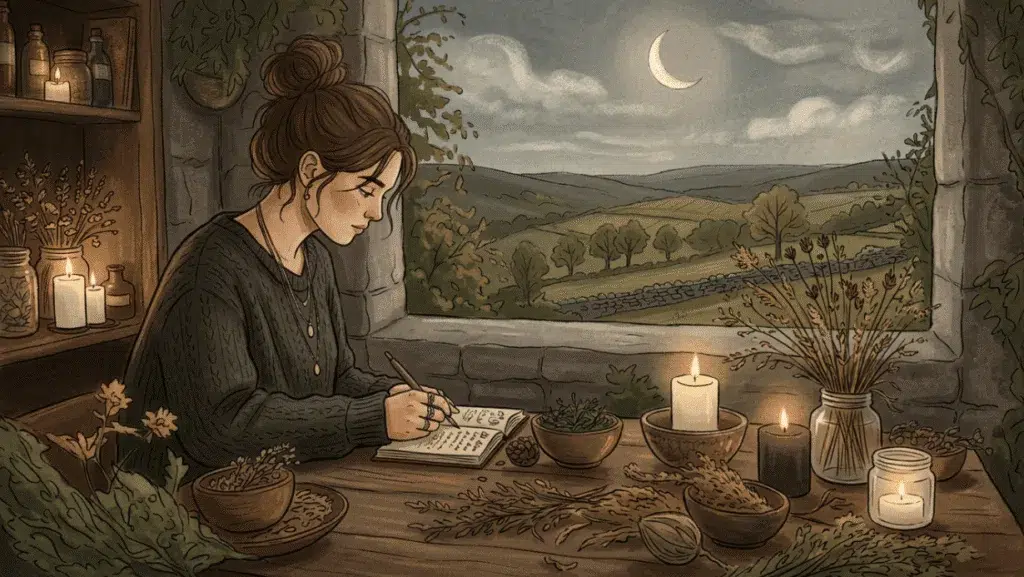
Choose one question.
One.
Not all thirteen because you have apparently decided to conduct a full internal audit before bedtime.
Light a candle if you want one, safely.
Sit somewhere comfortable.
Write the question at the top of the page.
Set a timer for ten or fifteen minutes.
Write without trying to make the answer wise or spiritual.
When the timer ends, stop.
Underline one sentence that feels important.
Then ask:
What is one gentle thing I can do with this information?
Close the journal.
The closing matters.
Dark Moon Tarot for Reflection
Tarot can be used as a reflective prompt rather than a machine for extracting hidden truths.
Try three cards:
What am I ready to acknowledge?
What needs compassion rather than judgement?
What is the next gentle step?
Keep the reading focused on your own choices and perspective.
If you become anxious, frightened or compelled to keep pulling cards until you receive a reassuring answer, stop the reading.
Sometimes the healthiest card is the one still in the deck.
A Dark Moon Release Ritual
Write one thing you are consciously choosing to release or reduce.
Be specific.
Not negativity.
Try:
Checking work email after dinner.
Replaying that argument.
Apologising every time I ask for something.
Keeping an obligation I no longer have capacity for.
Tear the paper into pieces or dispose of it normally.
You don’t have to burn it.
Fire is not compulsory for emotional closure.
Then choose one action that supports the release.
Turn off notifications.
Have the conversation.
Remove the reminder.
Change the routine.
Magic gives the decision a ritual shape. Behaviour helps it stick.
What If the Dark Moon Makes You Feel Nothing?
Excellent. You are not failing lunar witchcraft.
Not everybody experiences noticeable emotional or energetic shifts with lunar phases.
You can use the lunar cycle as a symbolic calendar without claiming the Moon is personally rearranging your mood every four weeks.
Or you can decide dark-moon work isn’t useful to you.
Your practice is allowed to be selective.
When Not to Do Shadow Work
Don’t force shadow work when you are already overwhelmed, exhausted, unsafe or emotionally flooded.
Don’t use it to punish yourself.
Don’t dig into traumatic material because a social-media challenge told you transformation requires discomfort.
Don’t assume every painful feeling contains a magical lesson.
Sometimes you need sleep.
Sometimes you need support.
Sometimes you need a professional.
Sometimes you need to stop journalling and watch something daft with a cup of tea.
The Dark Moon Can Be a Pause
The most useful dark-moon question may occasionally be:
What if I don’t do anything tonight?
Witchcraft can become strangely productive if we aren’t careful.
Every moon phase gets a ritual.
Every season gets goals.
Every emotion becomes shadow work.
Every problem becomes a spell.
You are allowed to experience the dark moon as a pause between cycles.
No manifestation list.
No release ceremony.
No breakthrough.
Just darkness, rest and the knowledge that the light will begin returning whether or not you filled three pages of your journal.
That is worth remembering too.
Handcrafted Tools