From the Spell Book
Scrying Ritual for Beginners: How to Start Scrying Simply
A grounded beginner scrying ritual using a dark bowl, mirror or reflective surface to practise observation, symbolism and intuitive reflection without forcing visions.
Table of Contents
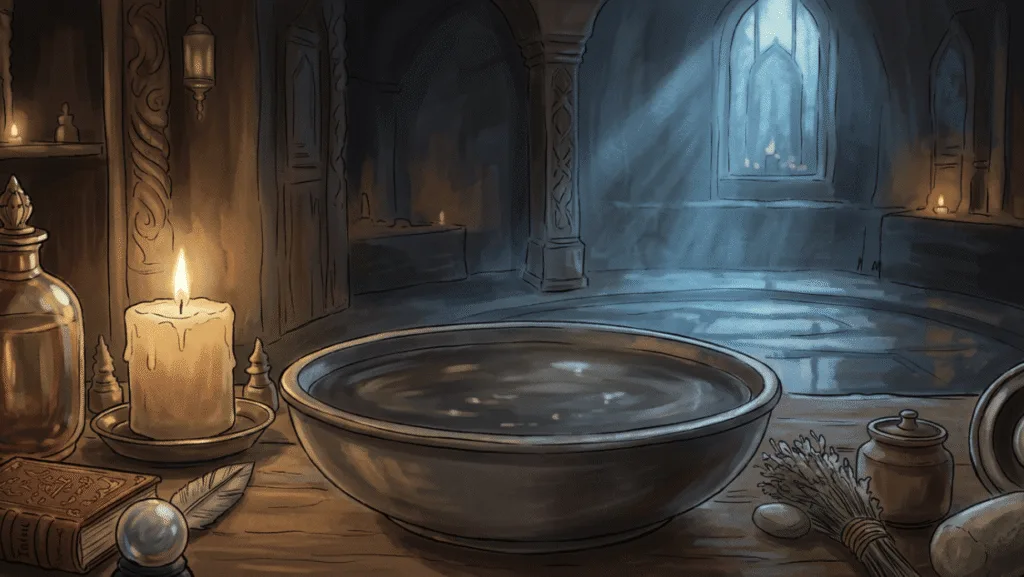
Scrying has an unfortunate reputation for looking wonderfully mysterious while leaving beginners staring into a dark bowl wondering whether the slightly wobbly shape is a spiritual message or simply their own nose reflected at an odd angle. At its simplest, scrying is a form of divination or contemplative practice in which you soften your focus on a reflective, dark or shifting surface and pay attention to the images, impressions and associations that arise. You might work with water, a dark mirror, a crystal or even flame, although this beginner ritual deliberately keeps things simple. You are not trying to force a vision. You are creating a quiet space to observe what your mind notices when it is given something ambiguous to look at.
What Scrying Is Actually For
Scrying is used in many modern magical and divinatory practices as a way of exploring intuition, symbolism and questions that benefit from reflection rather than a straightforward factual answer. The surface gives the eyes something simple and slightly ambiguous to rest on while the mind makes associations. Some practitioners understand the resulting impressions spiritually or psychically. Others approach them more like active imagination, meditation or symbolic reflection. You can leave room for mystery without deciding in advance that every flicker, shadow or mental image came from somewhere supernatural. For a beginner, the most useful goal is learning to observe without immediately forcing meaning onto what you see.
Start with a Question You Can Reflect On
Scrying is poorly suited to questions that require reliable factual information. Do not use a bowl of water to decide whether you need medical treatment, whether a financial investment is safe or whether another person is secretly doing something you have no evidence for. Better beginner questions include “What aspect of this situation am I overlooking?”, “What quality would help me approach this well?” or simply “What do I need to reflect on today?” You can also practise without a question at all. Whatever arises should be treated as material for reflection, not proof, prediction or instruction.
What You'll Need
You do not need an expensive black mirror or enormous crystal ball. A dark bowl and ordinary water make an excellent beginner setup, and they have the considerable advantage of probably already existing somewhere in your kitchen.
Essential:
• A dark-coloured bowl or other safe reflective surface
• Water if using a bowl
• A stable table or surface
• A notebook and pen
• A quiet, comfortably dim room
Optional:
• One candle placed safely behind or to the side of the bowl
• Mugwort for its divination associations
• Rosemary for clarity and protection
• Lavender for calm
• Amethyst, obsidian or moonstone if crystals are part of your practice
• A dark cloth beneath the bowl to reduce visual distraction
Alternative scrying surfaces:
• A purpose-made black scrying mirror
• A polished dark stone
• A crystal ball
• A bowl of plain water used in natural low light
Water: emotion, intuition, reflection and the subconscious in many magical systems.
Black or dark surfaces: mystery, depth, inward focus and reducing visual distraction.
Mugwort: widely associated in modern witchcraft with divination, dreams and intuition.
Rosemary: clarity, cleansing, remembrance and protection.
Lavender: calm, peace and a quieter mental atmosphere.
Amethyst: commonly associated with intuition, calm and spiritual reflection.
Obsidian: commonly associated with protection, truth and shadow work.
Moonstone: commonly associated with lunar energy, intuition and dreams.
Candlelight: illumination, focus and creating gentle movement across a reflective surface.
Scrying and Candle Safety
If you use a candle, place it where the flame cannot catch your hair, sleeves, notebook, herbs or cloth. Never leave it unattended. Avoid staring directly into a flame for prolonged periods. A dim lamp or natural twilight works perfectly well if candles are inconvenient. Do not add essential oils, herbs or unknown substances to a candle flame. If you use a mirror or polished stone, make sure it is stable and cannot fall or shatter. Stop the exercise if staring at the surface makes you dizzy, anxious, visually uncomfortable or unwell. Scrying does not need to involve sensory deprivation, sleep loss or substances.
Prepare the Scrying Space
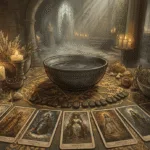
Choose somewhere you can sit comfortably for about ten to fifteen minutes without needing to hold your body in a dramatic occult pose. Put the dark bowl on the table and add enough water to create a clear reflective surface. If you are using a candle, place it behind or slightly to one side so its light reaches the water without the flame sitting directly in your line of sight.
Keep your notebook nearby but closed. Remove obvious distractions from around the bowl. You are trying to give your eyes less information, not construct a theatrical altar unless that genuinely helps you settle.
If you have a question, write it down once before beginning. Then take a few ordinary breaths and allow your shoulders and jaw to relax.
I look without chasing. I notice without forcing. I leave room for what arises.
The Beginner Scrying Ritual
1. Sit comfortably in front of your scrying surface. Let your eyes rest on the water or dark surface rather than staring hard at one exact point.
2. Take three slow breaths. Read or remember your question if you are using one, then say the first spoken words.
3. Allow your gaze to soften. You may find it easier to look slightly through the surface rather than trying to inspect it. Blink normally. This is not a competition to see who can develop the driest eyeballs in Lancashire.
4. Spend a few minutes simply observing. Notice changes in light, vague shapes, colours, memories, words, emotions or associations. Some may come from the surface itself and some may appear in your imagination.
5. Do not interrupt every impression to interpret it. If a shape reminds you of a tree, mentally note “tree” and continue. If nothing happens, continue observing the surface without assuming you are doing it wrong.
6. After roughly five to ten minutes, close your eyes or look away. Notice any final image, word or feeling that remains.
7. Open your notebook and record what you actually experienced before interpreting it. Write “dark shape like a doorway” rather than immediately writing “a portal means my ancestors are contacting me.” Description first, meaning second.
8. Once the observations are recorded, write possible associations beside them. What does a doorway mean to you? What was your first feeling about it? Does it connect naturally with your question?
9. Say the second spoken words and decide whether there is one useful reflection or practical question to carry away from the session.
10. End after ten to fifteen minutes. More time does not necessarily produce better scrying, particularly when your brain has started inventing shapes because it would quite like its tea.
I keep what is useful and release the need to make every shadow mean something.
What I see may be symbol, imagination, intuition or simple reflection. I can explore it without pretending certainty.
Close the Scrying Session
Say the final spoken words, extinguish the candle if you used one and turn the room lights back up. Pour the water away normally. You do not need to bury it, throw it at a crossroads or carry a mysterious bowl downstairs while everyone wonders what on earth you are doing. Put the tools away and do something ordinary for a few minutes. A drink, snack, stretch or bit of fresh air can help mark the shift back into everyday attention.
Keep a Scrying Record
If you want to develop the practice, try one short session a week for a month using the same basic setup. Record the date, question, observations and later interpretations. Over time you may notice recurring personal symbols or simply become better at sitting with ambiguity without immediately filling it with a story. Revisit your notes after several days. An image that seemed terribly profound at midnight may look rather different on Tuesday morning, and that is useful too.
What Counts as a Scrying Experience?
You do not need to see a crystal-clear moving picture in the water. Beginner experiences may include vague shapes, changes in perceived light, fleeting mental images, memories, colours, words, emotional reactions or nothing much at all. Visual perception naturally responds to ambiguous patterns, especially in low light, so seeing shapes is not proof of a supernatural event. The value of the practice lies in how thoughtfully you work with what arises. A quiet session with one interesting association can be more useful than an elaborate “vision” you had to force.
Don't Chase Visions
Avoid extending sessions because you feel you must make something happen. Do not deliberately exhaust yourself, deprive yourself of sleep, hyperventilate, use intoxicants or stare until your vision becomes uncomfortable in an attempt to produce an altered state. Be cautious about interpreting frightening imagery literally or treating it as a prediction of harm. If scrying increases anxiety, paranoia, dissociation or distress, stop the practice. Divination should not replace evidence, professional advice or real-world action when those are needed.
The Skill Is in Observing
Scrying becomes much less intimidating when you stop expecting the water to turn into a tiny supernatural television. The beginner skill is observation: noticing an impression, recording it accurately and then asking what it might mean to you.
With practice, you may develop a personal symbolic language around recurring shapes, feelings or associations. Or you may simply discover that ten quiet minutes staring into water gives your busy mind enough space to approach a question differently. Either can make the ritual worthwhile. Mystery is allowed. Certainty is not required.
Handcrafted Tools