From the Spell Book
Divination Protection Ritual Before Tarot, Runes or Scrying
A simple divination protection ritual to ground yourself, set boundaries and create a calm working space before tarot, runes, scrying or other intuitive practice.
Table of Contents
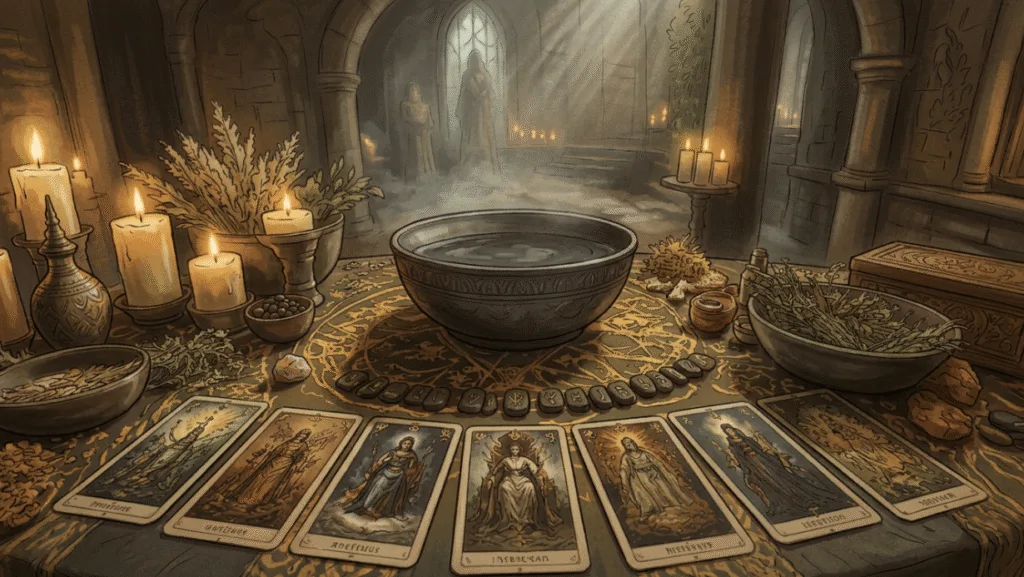
Protection before divination can become unnecessarily dramatic very quickly. You do not need to assume that opening a tarot deck has punched a supernatural hole through the living-room ceiling or that one slightly ominous rune means something is lurking behind the sofa. For many witches, protection is simply part of creating a deliberate working space. It can mark the boundary between everyday life and divination, help you settle your attention, reinforce what you are comfortable engaging with and give you a clear way to close the practice afterwards. This ritual can be used before tarot, oracle cards, runes, pendulum work or scrying, and it works whether you understand protection spiritually, psychologically, symbolically or as a mixture of all three.
What Protection Means in Divination
In witchcraft, protection may mean spiritual warding, energetic boundaries, creating sacred space or simply making a deliberate statement about what you welcome into a practice. Before divination, it can also be very practical. You are choosing the question, deciding the limits of the session and reminding yourself that a card, rune or image does not have authority over you. This ritual is not based on the idea that tarot, runes or scrying are inherently dangerous. It is about beginning from a position of steadiness rather than fear. If your tradition includes spirits, ancestors or deities, you can adapt the boundary language accordingly. If it does not, the ritual works perfectly well as a protective and grounding framework around your own intuitive practice.
Boundaries Matter More Than Fear
Before you begin, decide what the session is actually for. Choose a question or purpose and set a sensible limit on how long you will work. If you find yourself repeatedly pulling cards because you dislike the answer, asking the same frightening question in different ways or becoming more anxious with every interpretation, stop. Divination can be useful for reflection, but it should not become a substitute for factual information or a cycle of reassurance-seeking. For health, legal, financial, safeguarding or immediate safety matters, use appropriate real-world information and professional support. A protection ritual is not a reason to ignore ordinary precautions.
What You'll Need
The divination tool itself is the only specialist item. Everything else is optional and can be chosen from what you already have.
Essential:
• Your tarot or oracle deck, runes, pendulum, scrying surface or other divination tool
• A stable, comfortable place to work
Optional:
• A white or black candle in a safe holder
• Rosemary for protection, cleansing and clarity
• Bay leaves for protection and intention
• A small dish of salt as a boundary symbol
• A small bowl or glass of water
• Obsidian, smoky quartz or another protective stone if crystals are part of your practice
• A cloth for your cards, runes or tools
• A notebook and pen
• Your usual protection or cleansing oil if you already use one safely
White candle: clarity, cleansing, protection and adaptable all-purpose magical work.
Black candle: protection, boundaries, banishing and absorbing or containing unwanted influences in many modern witchcraft practices.
Rosemary: protection, cleansing, remembrance and mental clarity.
Bay: protection, intention, success and boundary work.
Salt: purification and protective boundaries across many folk and magical practices.
Water: cleansing, emotional balance and reflection.
Obsidian: commonly associated with protection, grounding and truth.
Smoky quartz: commonly associated with grounding, protection and releasing unwanted energy.
Circle or boundary: a deliberate limit around the working rather than something that must be physically drawn.
Fire, Salt and Practical Safety
Keep candles on a stable heat-resistant surface away from cards, cloth, paper, herbs, sleeves, pets and children. Never leave a flame unattended. You do not need to burn rosemary, bay or any other herb for this ritual. Keep salt away from electronics and from pets that may lick or eat it, and remember that scattering salt outdoors can damage plants and soil. If you use an altar oil, follow its directions and keep oils away from flames unless the product is specifically intended and formulated for candle use. A visualised boundary requires no physical ingredients and is often the easiest option.
Decide Your Boundary Before You Begin
Set out your divination tool but do not begin the reading yet. If you are using a candle, light it safely. Place rosemary, bay, salt, water or a protective stone nearby if you have chosen them.
Decide what you are asking and what your limits are. You might choose one question, one spread or a fifteen-minute session. If you work with spirits, ancestors or deities, decide specifically whom you welcome rather than issuing an open invitation to absolutely anything that happens to be passing. If your practice is secular or intuitive, define the boundary around your own attention instead: you are here to reflect clearly, not to spiral.
Place both feet on the floor if possible and take three slow breaths. Notice the physical room around you before turning your attention to the divination tool.
This space is mine to open and mine to close. I welcome only what supports clear, grounded and respectful work.
The Divination Protection Ritual
1. Begin by noticing the room. Name three ordinary things you can see or hear. This anchors the ritual in the place where you actually are before you move into symbolic or intuitive work.
2. If using rosemary, bay, salt, water or a stone, touch or gesture towards it and acknowledge the correspondence you have chosen. You do not need to pretend the ingredient is doing something spectacular. Let it represent the boundary you are setting.
3. Imagine a clear boundary around your working area. It might appear in your mind as light, a hedge, a circle, a cottage wall, a line in the earth or simply a sense of “this far and no further”. If visualisation is not your thing, place your hands on the table and state the boundary aloud instead.
4. Say the first spoken words once.
5. State the purpose of the session plainly. For example: “I am using these cards to reflect on how I can approach this conversation.” Avoid broad invitations such as “tell me anything I need to know” if open-ended work makes you uncomfortable.
6. Begin your tarot, rune, pendulum or scrying practice as normal. Keep the agreed limits. Protection includes protecting yourself from the temptation to turn one reading into seventeen because card number three annoyed you.
7. If an interpretation feels frightening, pause before accepting it. Ask what else the symbol could mean, whether the conclusion is supported by the rest of the reading and whether anxiety is filling in the gaps.
8. If you become uncomfortable, end the session. You do not have to complete a spread or continue a scrying exercise merely because you started it.
9. When the reading is complete, place the cards face down, gather the runes, still the pendulum or look away from the scrying surface. Say the second spoken words.
10. Imagine the boundary closing or returning to its ordinary state. You are not trapped inside it and you have not left a mystical door swinging open. The ritual is finished because you have decided it is finished.
The reading is complete. I keep what is useful, release what is not, and close this working now.
My tools are quiet. My space is my own. I return fully to the ordinary world around me.
Close and Reset the Space
Say the final spoken words. Extinguish the candle, put away the divination tools and clear any loose ingredients. Salt can go into household waste rather than the garden. Water can be poured away normally. If you used herbs symbolically and they are still clean and usable, store them rather than throwing them out for the sake of ritual theatre. Open a curtain, turn on a normal light, wash your hands, make a brew or do something else pleasantly mundane. Closing should feel like returning your attention to ordinary life, not escaping from something frightening.
Protect Your Relationship with Divination Too
The most useful protective habit may be knowing when not to read. If you are extremely anxious, exhausted, angry or desperate for one particular answer, it can be difficult to interpret ambiguous symbols fairly. Write the question down and come back later. Keep notes if repeated readings are becoming a habit. If you have already asked essentially the same question, work with the information you have before reaching for another spread. Your divination tools can wait. They are generally very patient objects.
Signs the Ritual Is Doing Its Job
A successful protection ritual does not require a dramatic energetic sensation. You may simply feel more settled, less tempted to keep pulling clarifiers, clearer about the purpose of the reading or more able to stop when the session is finished. You might also find it easier to distinguish between an uncomfortable interpretation and genuine panic. The useful sign is that your divination practice has clearer edges. You know when you have begun, what you are doing and when you are done.
Protection Shouldn't Make Divination Scarier
If your protective routine starts convincing you that ordinary tarot, runes or scrying are constantly exposing you to danger, reconsider the routine. Protection is supposed to support steadiness, not manufacture fear. Avoid interpreting every dropped card, candle flicker, strange noise or uncomfortable thought as evidence of an attack or unwanted entity. Houses creak. Flames move. Cards fall on the floor because hands are inconveniently human. If a spiritual practice is increasing paranoia, fear, compulsive checking or distress, stop and seek appropriate support rather than adding increasingly elaborate magical defences.
You Decide When the Reading Ends
A good divination boundary is surprisingly empowering. You are not sitting passively while cards, runes, spirits, fate or the universe dictate what happens next. You choose the question. You choose the method. You decide how seriously to take an interpretation. And you decide when the session is over.
That is the heart of this protection ritual. The candle, herbs, salt and stones can help give the boundary shape, but they are not the authority in the room. You are. Begin deliberately, read thoughtfully and close clearly. Then put the kettle on and return to the rest of your life.
Handcrafted Tools