From The Grimoire
Lammas and Lughnasadh: First Harvest Magic for Modern
By the end of July, summer has changed. The evenings are still long. Gardens are full. Hedgerows are busy. Fields are ripening. But there is a shift.
Table of Contents
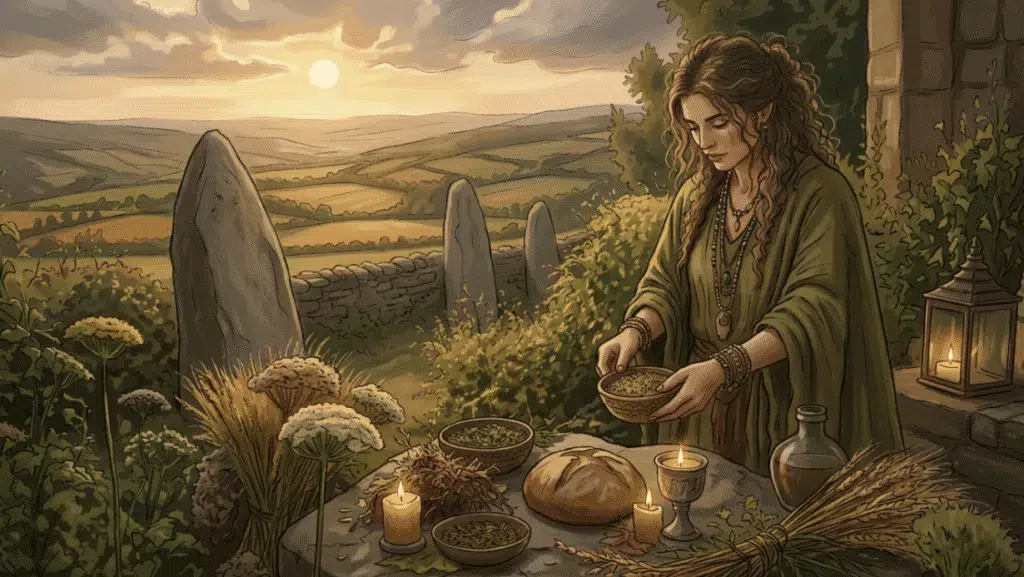
By the end of July, summer has changed.
The evenings are still long. Gardens are full. Hedgerows are busy. Fields are ripening.
But there is a shift underneath it.
The longest day has passed. The light is slowly shortening. Harvest begins to replace growth as the seasonal story.
This is the territory of Lammas and Lughnasadh, festivals commonly celebrated around 1 August and associated in modern Pagan practice with the first harvest.
For a green witch, it is a lovely point in the year to notice what has grown, what is becoming ready, and what all that spring effort has actually produced.
Even if the only thing you’ve successfully harvested from the garden is courgettes.
Especially then. There are always more courgettes.
What Are Lammas and Lughnasadh?
Lammas and Lughnasadh are often grouped together in modern Wheel of the Year celebrations, but they do not have identical origins.
Lughnasadh is an Irish seasonal festival with deep roots in Gaelic tradition, historically associated with gatherings, games, feasting, trade and the beginning of the harvest season. Its name is connected with the god Lugh.
Lammas comes from the Old English idea of loaf-mass and is associated with the blessing of bread made from the new grain harvest in Christian tradition.
Modern Pagan and witchcraft practice has often brought first-harvest themes from these histories together within the Wheel of the Year.
That doesn’t mean the two words are simply interchangeable historically.
You can celebrate a modern first-harvest Sabbat while still respecting that the traditions behind the names are different.
When Is Lammas or Lughnasadh Celebrated?
The most common modern date is 1 August, although celebrations may take place around the beginning of August depending on tradition, community and personal practice.
You don’t need to panic if 1 August is a workday and your schedule contains considerably more commuting than ceremonial grain harvesting.
Celebrate when you can meaningfully notice the season.
The harvest will not be offended by your calendar.
Why Is It Called the First Harvest?
Within the modern Wheel of the Year, Lammas or Lughnasadh is often treated as the first of three harvest festivals.
Lammas/Lughnasadh focuses strongly on grain and the beginning of harvest.
Mabon, around the Autumn Equinox, is often framed as a second harvest associated with balance, fruit and the fuller abundance of autumn.
Samhain marks the later end of the harvest cycle and movement into the darker part of the year.
Real agricultural harvests vary by crop, weather and location, of course.
The Wheel is a symbolic seasonal framework, not a farming timetable issued by the universe.
What Does the First Harvest Mean Magically?
Spring magic often focuses on beginnings.
Seeds.
Plans.
Potential.
Summer brings growth, action and expansion.
First-harvest magic asks a different question:
What is becoming ready?
What have your efforts produced?
What can you use now?
What still needs time?
What did not grow the way you expected?
This makes Lammas an excellent season for gratitude, prosperity, work, skills, creativity, achievement and honest reflection.
Harvest isn’t only about celebrating success.
It’s also about looking clearly at results.
You can plant six things and discover that only two actually wanted to grow.
Gardens are quite good at teaching project management.
Bread and Grain Symbolism
Bread is one of the strongest symbols associated with Lammas.
Grain begins as seed, grows through months of work and weather, is harvested, ground and transformed into food.
That makes bread a powerful symbol of labour becoming something sustaining.
You can bake bread as part of your celebration if you enjoy baking.
You can buy bread if you don’t.
There is no spiritual requirement to prove devotion by spending six hours arguing with sourdough starter.
Choose a loaf you enjoy and make it part of a meal or simple ritual.
A Simple Bread Blessing
Place your bread on the table before eating.
Rest your hands near it and think about the work behind it.
The seed.
Soil.
Weather.
Farmers.
Harvest.
Milling.
Baking.
Transport.
The money that bought it.
The people sharing it, if you’re not alone.
Then say:
From seed to grain,
from work to harvest,
may what sustains me be honoured.
May I recognise what has grown,
and use it well.
Then eat the bread.
Ritual food is allowed to become lunch afterwards.
A First Harvest Altar
A Lammas altar can be wonderfully simple.
Use what reflects the season where you live.
Grain or bread.
Seasonal flowers.
Herbs from the garden.
Apples or early fruit if available.
A yellow, gold, orange, brown or green candle.
Seeds.
A small basket.
A representation of the Sun beginning its decline.
Something representing your own harvest from the year so far.
That last item makes the altar personal.
Perhaps it is a finished project.
A certificate.
A photograph.
A product you created.
A notebook full of work.
A key representing a move.
Something your child made.
The harvest doesn’t need to be agricultural to be real.
Herbs for Lammas Magic
Use seasonal herbs that fit both your local environment and your magical intention.
Rosemary can represent remembrance, protection and cleansing.
Basil works well with prosperity and success.
Chamomile can connect with luck and prosperity.
Calendula has bright associations with confidence and success.
Bay can represent wishes, success and protection.
Garden sage can support wisdom, cleansing and protection.
If you’re harvesting your own plants, identify them correctly and harvest responsibly.
If using dried ritual herbs from a magical supplier, remember that they are spellcraft ingredients unless specifically sold as food grade.
Do not turn the altar into tea because the herb packet looked wholesome.
A Harvest Gratitude Bowl
Place a bowl on your altar or table.
Over the week around Lammas, add small written notes describing things that have come to fruition.
Not only enormous achievements.
A bill paid.
A difficult conversation handled.
A plant grown.
A friendship maintained.
A new skill learned.
A project finished.
A customer gained.
A family problem survived.
A day when you got out of bed and did what needed doing even though you really couldn’t be arsed.
Harvest includes effort that doesn’t photograph beautifully.
At the end of the week, read the notes and recognise what you’ve actually done.
First Harvest Prosperity Magic
Lammas is naturally associated with abundance, but prosperity magic works best when we define abundance more carefully than MORE STUFF PLEASE.
Ask what you need to grow sustainably.
Reliable income?
More customers?
Time?
Skills?
Support?
Opportunities?
Confidence to charge properly for your work?
Write one practical prosperity goal on a piece of paper.
Place it beneath a candle or beside a small bowl containing symbolic herbs such as basil, chamomile or bay.
Speak the intention.
Then identify the next mundane action.
Update the listing.
Send the proposal.
Review the pricing.
Apply for the role.
Put money into savings.
Magic and spreadsheets are perfectly capable of being friends.
A Lammas Candle Ritual
Choose a candle in a harvest colour or simply use one you already have.
Place beside it one symbol of something you have achieved since the beginning of the year.
Light the candle safely.
Look at the object and say:
I honour the work that brought me here.
I recognise what has grown.
I gather what is ready.
I continue tending what still needs time.
Spend a few minutes reflecting on what the next stage requires.
Then extinguish the candle safely.
This is not a ritual about pretending everything succeeded.
It is about seeing what actually exists now.
What Didn't Grow?
Harvest includes failure.
Some seeds don’t germinate.
Some projects stall.
Some plans turn out to be terrible ideas once they meet reality.
Some goals mattered in January and don’t matter at all by August.
Lammas can be a good time to stop pouring energy into something simply because you started it.
Ask:
What have I been tending that is producing nothing useful?
Does it need more time?
A different approach?
Or permission to end?
There is no prize for faithfully watering a dead plan until December.
Harvesting Your Skills
One of my favourite non-agricultural ways to work with first-harvest symbolism is to look at skills.
What can you do now that you couldn’t do at the beginning of the year?
Maybe you learned tarot.
Built a website.
Started identifying local plants.
Learned to bake bread.
Got better at saying no.
Made something by hand.
Understood a part of your witchcraft more deeply.
Skills are a harvest because practice accumulates.
You put effort in repeatedly and eventually realise something has changed.
Write down three things you can do now that once felt difficult.
Keep the list somewhere you can find it when impostor syndrome starts talking nonsense.
Celebrating Lammas in the Garden
If you garden, the first harvest theme is beautifully literal.
Harvest something that is ready.
Herbs.
Beans.
Tomatoes.
Potatoes.
Courgettes. Obviously courgettes.
Notice what is still growing.
Notice what has gone to seed.
Notice which plants struggled.
You don’t need to turn every gardening task into ceremony.
Simply harvesting dinner with awareness of the season can be enough.
If you don’t have a garden, visit a market, allotment shop, farm shop or greengrocer and notice what is locally abundant.
Seasonal witchcraft doesn’t require land ownership.
Celebrating Lammas on a Budget
First-harvest celebrations are particularly easy to keep inexpensive because the theme is using what is already available.
Eat bread.
Take a walk.
Pick herbs from your own garden if you have them.
Write gratitude notes.
Cook a seasonal meal.
Light a candle you already own.
Collect fallen natural materials where permitted.
Watch the evening light.
You don’t need a new Sabbat haul every six weeks to prove you’re following the Wheel.
The season is outside. It hasn’t put anything in your basket.
Celebrating Alone
A solitary Lammas celebration can be quiet and deeply personal.
Bake or buy something nourishing.
Set a small place at the table deliberately.
Light a candle.
Write down what you have achieved since Imbolc or Ostara.
Take a walk through the evening landscape.
Make plans for what you want to complete before autumn.
You don’t need a coven to notice harvest.
You are allowed to celebrate the Wheel privately, imperfectly and in your own kitchen.
Celebrating With Children and Family
First harvest themes are easy to bring into ordinary family life without requiring everybody to participate in formal ritual.
Bake together.
Visit a local market.
Harvest something from the garden.
Make a meal using seasonal produce.
Talk about something each person has learned or achieved this year.
Make simple bread shapes.
Collect seeds from suitable garden plants for next year.
The family activity can be the celebration.
Nobody needs to stand in a circle while a teenager looks like they would rather be anywhere else on Earth.
Lammas in Northern England
Seasonal witchcraft becomes much richer when we notice the actual landscape rather than trying to recreate somebody else’s climate.
Here in Lancashire, late July and early August can bring warm evenings, heavy rain, fields moving towards harvest, blackberries beginning to appear, gardens overflowing and the first subtle sense that summer is no longer endless.
The light has changed since Litha.
You may notice sunset arriving a little earlier.
The countryside looks full rather than fresh.
Growth has weight now.
That is first-harvest magic happening around you before you’ve lit a single candle.
Lammas, Lughnasadh and Cultural Respect
If you want to explore Lughnasadh specifically, learn about its Irish history rather than treating the name as simply an alternative spelling for a generic harvest festival.
Modern Pagan Wheel of the Year practice draws from multiple historical and cultural strands that were not originally one unified ancient religion.
We don’t need to flatten those differences to have a meaningful modern practice.
You can say:
This is how I celebrate the first harvest as a modern witch.
And separately ask:
Where do these names and traditions actually come from?
Both questions make the practice stronger.
A First Harvest Reflection
At Lammas, ask yourself:
What has grown?
What is ready?
What am I proud of?
What needs harvesting now rather than endlessly perfecting?
What still needs time?
What failed, and what did it teach me?
What resources do I have that I wasn’t recognising?
What can I share?
What should I stop tending?
These are useful questions for gardens, businesses, relationships, creative work and magical practice alike.
A Simple Lammas Blessing
May I recognise the harvest before me.
May I honour the work that brought it forth.
May I gather what is ready,
share what I can,
and continue tending what still needs time.
May I release what did not grow,
without mistaking it for wasted effort.
As the light slowly turns towards autumn,
may I know that enough can be sacred too.
The First Harvest Is About More Than Abundance
Lammas is often presented as a festival of abundance.
It is.
But harvest is more interesting than simply having plenty.
Harvest is work becoming visible.
It is choosing what to gather.
Using what has grown.
Saving something for later.
Sharing when we have enough.
Learning from what failed.
And recognising that the season is already beginning to turn.
You don’t need a field of wheat to understand that.
Look at what you’ve been growing since winter.
Some of it may finally be ready to bring home.
Handcrafted Tools