From the Spell Book
Samhain Ancestor Candle Ritual for Remembrance
A gentle Samhain ancestor candle ritual for remembrance, family history and honouring the dead without claiming to summon or speak for them.
Table of Contents

Samhain arrives as the landscape settles properly into the darker half of the year. Leaves are down, evenings close in early and the season naturally lends itself to memory. In modern Pagan and witchcraft practice, Samhain is strongly associated with ancestors, the dead, divination and the idea of a thinning veil. Older Irish Samhain traditions are broader and more complex than the modern shorthand suggests, so this ritual is deliberately framed as remembrance rather than an attempt to reproduce an ancient séance. Light a candle. Name somebody you want to remember. Tell a story about them. You do not need to receive a supernatural reply for remembrance to be meaningful.
What This Samhain Ancestor Ritual Is For
This is a contemporary remembrance ritual for Samhain. It can be used to honour relatives, chosen family, community ancestors, cultural forebears or another person whose life helped shape yours. It does not require you to believe that the dead are literally present, and it does not claim to open communication with them. If ancestor work is part of your spiritual practice, you can bring those beliefs with you. If it is not, the ritual still works as an intentional act of memory, gratitude and family or community history.
Choose Whom You Actually Want to Remember
Ancestor practice does not require you to honour every person in your biological family line. Families can contain love, estrangement, abuse, secrecy, adoption, migration, loss and people you barely know anything about. Choose somebody whose memory feels appropriate and safe to hold. You might remember a grandparent, friend, teacher, local forebear, craftsperson, activist, queer elder, spiritual predecessor or somebody from your chosen family. If you know very little about your ancestry, you can honour the unnamed people whose ordinary lives made yours possible without inventing personalities or stories for them.
What You'll Need
One candle and one remembered name are enough. Photographs, heirlooms and family foods can make the ritual more personal, but they are optional.
Essential:
• One white or ivory candle in a safe holder, or an LED candle
• A piece of paper and pen
Optional:
• A photograph, copy of a photograph or written name
• A small heirloom or object connected with the person
• Rosemary for remembrance and protection
• An apple or other seasonal food connected with your family or locality
• Oak leaves or acorns gathered responsibly
• A small glass of water
• A family recipe, letter or story
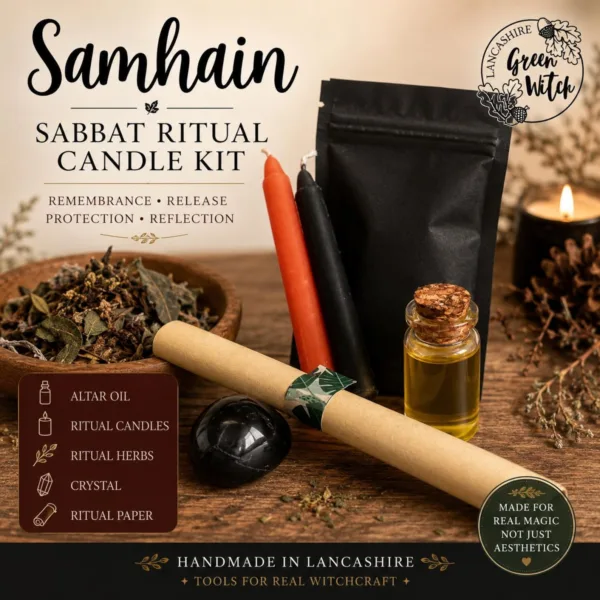
• A suitable Samhain altar oil used according to its directions
Candlelight: remembrance, vigil, attention and the presence of memory.
Rosemary: remembrance, protection and clarity.
Apples: autumn harvest, nourishment and extensive folklore associations.
Oak: endurance, ancestry, strength and continuity symbolism.
Water: reflection, memory and hospitality in modern ritual practice.
Photographs and names: personal memory and documented connection rather than magical proof of presence.
Samhain: a Gaelic seasonal festival with historical traditions that developed over time; modern Pagan practice commonly emphasises ancestors, the dead, divination and the transition into the darker season.
Candle, Grief and Family Safety
Keep candles on a stable heat-resistant surface away from photographs, letters, dried leaves, fabric and other flammable keepsakes. Use copies rather than irreplaceable originals near flame. An LED candle is absolutely fine. Do not eat ritual food unless it is correctly identified, safely stored and suitable for you. Emotionally, stop or simplify the ritual if it becomes overwhelming. Grief can remain intense or complicated long after a death, and difficult family histories can bring up more than nostalgia. Spiritual ritual can accompany appropriate grief, mental-health or safeguarding support, but it should not replace it.
Prepare a Memory, Not a Message from the Dead
Write the person’s name, or a description such as Those Before Me Whose Names I Do Not Know. Beneath it, write three things you genuinely know or remember. They might be facts, stories, phrases they used, work they did, food they cooked, music they loved or something they taught you.
Then write one thing you carry forward. Perhaps it is a skill, value, recipe, stubborn streak, warning, family story or determination to do something differently.
If your knowledge comes from family stories, treat it as family memory rather than automatically as verified historical fact. There is no need to fill gaps with imagined certainty.
I light this flame in remembrance. I honour what I know, hold gently what I do not, and make no claim to speak for the dead.
The Samhain Ancestor Candle Ritual
1. Set the candle safely in front of you. Place the photograph, written name or other remembrance object nearby, keeping anything flammable well away from the flame.
2. Light the candle or switch on the LED candle. Take three slow breaths and allow the room to become quiet.
3. Read the name aloud. If you are honouring unnamed ancestors or forebears, use the wording you prepared.
4. Say the first spoken words.
5. Read your three memories or known facts. Take your time. If another story comes to mind, tell it. Remembrance does not need to be solemn every second. If the person was funny, ridiculous, difficult or famously terrible at making gravy, that belongs to memory too.
6. Place the rosemary or another chosen symbol beside the name. Say the second spoken words.
7. Read the thing you carry forward. If it is something you want to continue, name one way you will keep it alive. Cook the recipe. Tell the story to your children. Practise the craft. Visit the place. Write the history down.
8. If what you carry forward is instead a pattern you intend to change, say so plainly. Honouring ancestry does not require repeating everything inherited from it.
9. Sit quietly for a few minutes. Thoughts, emotions and memories may arise. You can record them afterwards, but do not feel obliged to label every sensation, candle movement or household noise as contact from the dead.
10. Say the final spoken words and extinguish the candle safely.
What was loved can be remembered. What was learned can be carried. What caused harm does not have to be repeated.
The candle closes, but the story remains. I return to the living carrying only what is mine to carry.
Close by Returning to the Living
Extinguish the candle safely and put photographs or heirlooms somewhere secure. Drink some water, eat something, speak to somebody you love or do another ordinary grounding activity. Samhain remembrance should have a clear ending. You do not need to keep yourself in a heightened spiritual state for the rest of the night, and you certainly do not need to remain awake until 3am analysing why the radiator clicked during Grandad’s story.
Keep the Story Alive in Ordinary Ways
If the ritual brought up a story worth preserving, write it down properly while you remember it. Label old photographs. Ask an older relative about a name. Record a recipe. Research a place using reliable archives. Share a memory with younger family members if appropriate. These ordinary acts of preservation can be powerful ancestor work in their own right because they stop real names, voices and experiences disappearing into an increasingly mysterious box of unlabelled photographs.
Signs the Ritual Has Done Its Work
The most useful signs may be very human ones: remembering a forgotten detail, feeling connected with a story, deciding to preserve family information, allowing grief some space or recognising both what you value and what you want to change in an inherited pattern. Dreams or unusual experiences may feel meaningful within your personal beliefs, but this ritual does not treat them as objective proof that a dead person has communicated with you.
You Do Not Owe Every Ancestor Reverence
Biological relationship does not make harmful behaviour sacred. If a particular relative is associated with abuse, fear or trauma, leave them out. You can work with chosen family, collective ancestors or nobody at all. Likewise, do not use ancestor practice to make definitive claims about cultures, identities or spiritual traditions you have not actually established a connection to. Genealogy can contain surprises, gaps and family myths. Respect uncertainty. If remembrance intensifies grief or trauma beyond what feels manageable, stop and seek appropriate support.
Remembrance Is Enough
Samhain gets wrapped in a great deal of dramatic language about veils, spirits and messages from beyond. Those beliefs can be meaningful parts of somebody’s practice, but they are not required for a powerful night of remembrance.
Sometimes the magic is much quieter.
You light the candle. You say a name that has not been spoken for a while. You remember the way somebody laughed, the work their hands did, the recipe nobody wrote down properly or the family habit you have consciously decided ends with you.
The dead do not need to perform for us to matter. Remembering them is already an act.
Handcrafted Tools